For exclusive release to Wood
& Wood Products
Copyright
© October 22, 2012 Woodworking Network – Vance Publishing
Media
contact: Lynn Gorman 352-489-4788; lynn@gorcomm.com
Everyone pitches in to bring
computer integrated manufacturing classes to a rural high school
 [JACKSON,
KY – JULY 2010] For
nearly a decade, Ken Combs taught computer-aided drafting
classes at Breathitt County High School in rural Jackson,
Kentucky. One of the highlights of his program was taking
students in his classes to the University of Kentucky’s Wood
Manufacturing Lab, also located in Jackson. There his students
would be given their own workstations so that they could take
some of the 2D designs they had created in AutoCAD (from
Autodesk, Inc., San Rafael, CA), import them into Mastercam
(from CNC Software Inc., Tolland, CT), create CNC toolpaths, and
finally manufacture their designs on the lab’s large CNC
router. [JACKSON,
KY – JULY 2010] For
nearly a decade, Ken Combs taught computer-aided drafting
classes at Breathitt County High School in rural Jackson,
Kentucky. One of the highlights of his program was taking
students in his classes to the University of Kentucky’s Wood
Manufacturing Lab, also located in Jackson. There his students
would be given their own workstations so that they could take
some of the 2D designs they had created in AutoCAD (from
Autodesk, Inc., San Rafael, CA), import them into Mastercam
(from CNC Software Inc., Tolland, CT), create CNC toolpaths, and
finally manufacture their designs on the lab’s large CNC
router.
This exposure to a complete
manufacturing environment within a single educational lab was an
eye-opener for Combs. After attending one of these labs, he
thought, "This is an experience our students should be
having every day, not just once a year." Several years ago
he got the opportunity to make that wish a reality when the
school’s veteran shop teacher retired and Combs was asked to
take over his shop class.
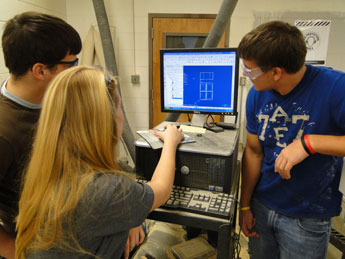 Soon
he was lobbying the administration to purchase a CNC router and
the CAM (computer-aided manufacturing) software to program it.
In 2007, they agreed and cut a purchase order for the equipment.
However, the manufacturer declared bankruptcy shortly
afterwards, and the school department was out the money and had
no equipment to show for it. Soon
he was lobbying the administration to purchase a CNC router and
the CAM (computer-aided manufacturing) software to program it.
In 2007, they agreed and cut a purchase order for the equipment.
However, the manufacturer declared bankruptcy shortly
afterwards, and the school department was out the money and had
no equipment to show for it.
To its credit, the school
administration allowed Combs to go shopping again in 2009. This
time, industry leaders were chosen to supply the equipment and
software – a Techno Router (manufactured by Techno, Inc., New
Hyde Park, NY) and Mastercam X4 CAD/CAM software. The arrival of
goods, along with extensive technical support and training at
the start of the school year, marked the beginning of Breathitt
County High School's Computer-Integrated Manufacturing class.
A Good Start
 With
the exception of his limited experiences at the University of
Kentucky, Combs had no experience using the CNC equipment or CAM
programming software. Combs needed some assistance. Techno's
James Renner came to the school early in September and worked
with Combs for a day before the machine was delivered. He
emphasized the importance of getting the router and software
working together flawlessly before training so that no valuable
time would be consumed solving problems. With
the exception of his limited experiences at the University of
Kentucky, Combs had no experience using the CNC equipment or CAM
programming software. Combs needed some assistance. Techno's
James Renner came to the school early in September and worked
with Combs for a day before the machine was delivered. He
emphasized the importance of getting the router and software
working together flawlessly before training so that no valuable
time would be consumed solving problems.
Next there was support provided
by Dan Newby
and others from Mastercam. Those guys were great. "Between
e-mail, callbacks, and me calling them, they helped me for hours
and hours to get this thing up and running before our Techno
Router arrived," Combs said.
Because of his proficiency with
AutoCAD, Combs had no difficulty mastering the basic concepts of
the CAM software. He thought the interfaces were remarkably
similar.
About a month after his initial
visit, Renner returned to provide Combs with a day of hands-on
training. Then Combs was ready to launch the new program with
the comforting knowledge the support from his new suppliers was
only a phone call away.
Everyone Pitched In
 He
was not entirely without resources. For example, the
administration made a major contribution by changing the class
schedule from single one-hour periods to double periods. This
eliminated half of the setup and cleanup work that unavoidably
consumes a lot of class time, giving students more of an
opportunity to immerse themselves in their work. He
was not entirely without resources. For example, the
administration made a major contribution by changing the class
schedule from single one-hour periods to double periods. This
eliminated half of the setup and cleanup work that unavoidably
consumes a lot of class time, giving students more of an
opportunity to immerse themselves in their work.
Some of Combs’ 25 students
also proved to be invaluable resources. A number of them were
recruited from his drafting and conceptual design classes.
"I said to them 'Hey
if you like drafting, how would you like to actually learn how
to draft and then go build it?' "
These students would be the
lead CAM programmers and CNC equipment operators. One of their
main assignments was to study the excellent manuals and training
materials provided by Techno and Mastercam, and figure out how
these new systems could be quickly integrated into classroom
project
The computer-integrated
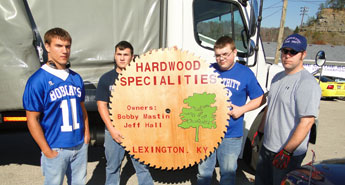
manufacturing class also received a significant gift from a
local tool and building supply distributor (Hardwood
Specialties, Lexington, KY) which donated a truckload of
slightly damaged wood for the students to practice on. As a
display of gratitude, the students made a four-foot sign in the
shape of a table saw blade, that is now prominently located at
the company.
Bringing Projects to Life
 Soon,
Combs and his students were getting into high gear with class
work and starting to make objects that could be sold to offset
the cost of the students' projects. He said, "We are in a
rural area of eastern Kentucky. Very few kids have 100 or 200
bucks to drop on a wood project. So we did a fundraiser in the
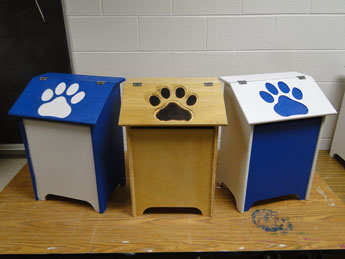
fall. We designed a potato and onion bin. On the lid we engraved
a bobcat because we are the Bobcats. Soon,
Combs and his students were getting into high gear with class
work and starting to make objects that could be sold to offset
the cost of the students' projects. He said, "We are in a
rural area of eastern Kentucky. Very few kids have 100 or 200
bucks to drop on a wood project. So we did a fundraiser in the
fall. We designed a potato and onion bin. On the lid we engraved
a bobcat because we are the Bobcats.
"We made 30 to 40 of
these, painted them up, some of them clear finish, and we've
been selling them at ball games, and e-mailing people. If we can
sell them all, that will make a big contribution toward every
kid's individual project. So they'll only be out of pocket about
$25 and they'll have something they can keep for the rest of
their lives."
And just what would that
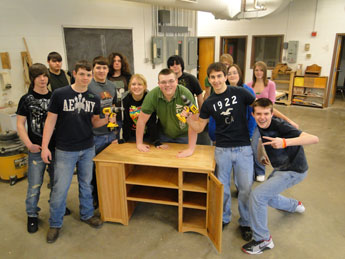
something be? Combs
gathered his students around the blackboard for a brainstorming
session about what to make for their class project. The top two
contenders were a computer desk and an entertainment center.
Then it occurred to them that they could design a unique piece
of furniture that could be adjusted and used for either purpose.
The design they arrived at was
so attractive that a number of teachers have expressed interest
in purchasing one for their own use. Consequently, the class
will over-produce them so that sales of the additional items
will allow the students to take their own work home without
incurring any additional costs.
Just Like Manufacturing
The winter of 2010 turned out to be one of Kentucky's worst.
Snowstorms and blizzards that normally stay up north visited the
region en masse. The students had lost nearly two weeks of class
time before March was over. If they were going to get all of the
projects completed and have enough additional units to sell to
other interested parties, it would be necessary to ramp up their
productivity.
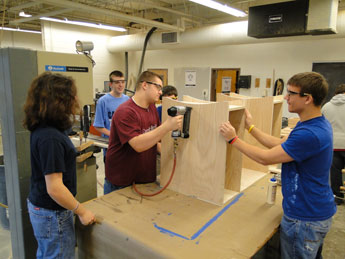
The shop only has one CNC
router but plenty of conventional equipment including band saws,
table saws, and hand tools. A plan was devised in which the
router would be used to make templates and relief cuts that
would serve as guides the students could use for cutting and
drilling parts with conventional equipment. So, using all the
resources available, the shop has been set up as a complete
manufacturing operation from design to CAM programming, to CNC
machining, to conventional cutting, to final assembly and
finishing.
"We're all learning
together," said Combs. "The
more advanced students are doing all the toolpaths and cutter
comp, setting up the table and spool bores, then running the
files and the machine. The other kids - some on the band saw and
some on the table saw-- are cutting dados and rabbets,
finalizing arcs predefined on the CNC machine, then
engraving."
This is now the "Bobcat
Workshop", so every piece of this unique furniture design
is proudly engraved with a bobcat image. "Then we are
taking those pieces into an assembly process so we can mass
produce our furniture--just like in manufacturing," Combs
concluded.
Combs and his students feel
very good about their accomplishments learning new technologies
and integrating them into their class work in ten short months,
but what would an independent expert have to say?
Combs recently e-mailed James
Renner some photos of the work his students were producing, and
the Techno executive was very impressed. He immediately wrote
back to Combs:
"There are a lot of
teachers out there that are either afraid of the technology or
have a machine and Mastercam and don't know how to get started.
I wrote the book for those teachers. I want them to at least
have a fighting chance of success… I
want you to know how proud of you I am. You
have learned more in a few months than some instructors I know
who have had the machine for years."
As Combs was helping his
students race to the finish line, he was also giving some
thought to what he might do to bring his program up another
level next year.
|



 Techno,
Inc. is celebrating 25 years of CNC and Automation Technology
expertise. Our Educational Division provides industrial quality products
at educational prices with a network of award winning Educators, we can
provide CNC Curriculums, CNC Projects, Technical Information and
Packages for any educational classroom.
Techno,
Inc. is celebrating 25 years of CNC and Automation Technology
expertise. Our Educational Division provides industrial quality products
at educational prices with a network of award winning Educators, we can
provide CNC Curriculums, CNC Projects, Technical Information and
Packages for any educational classroom.